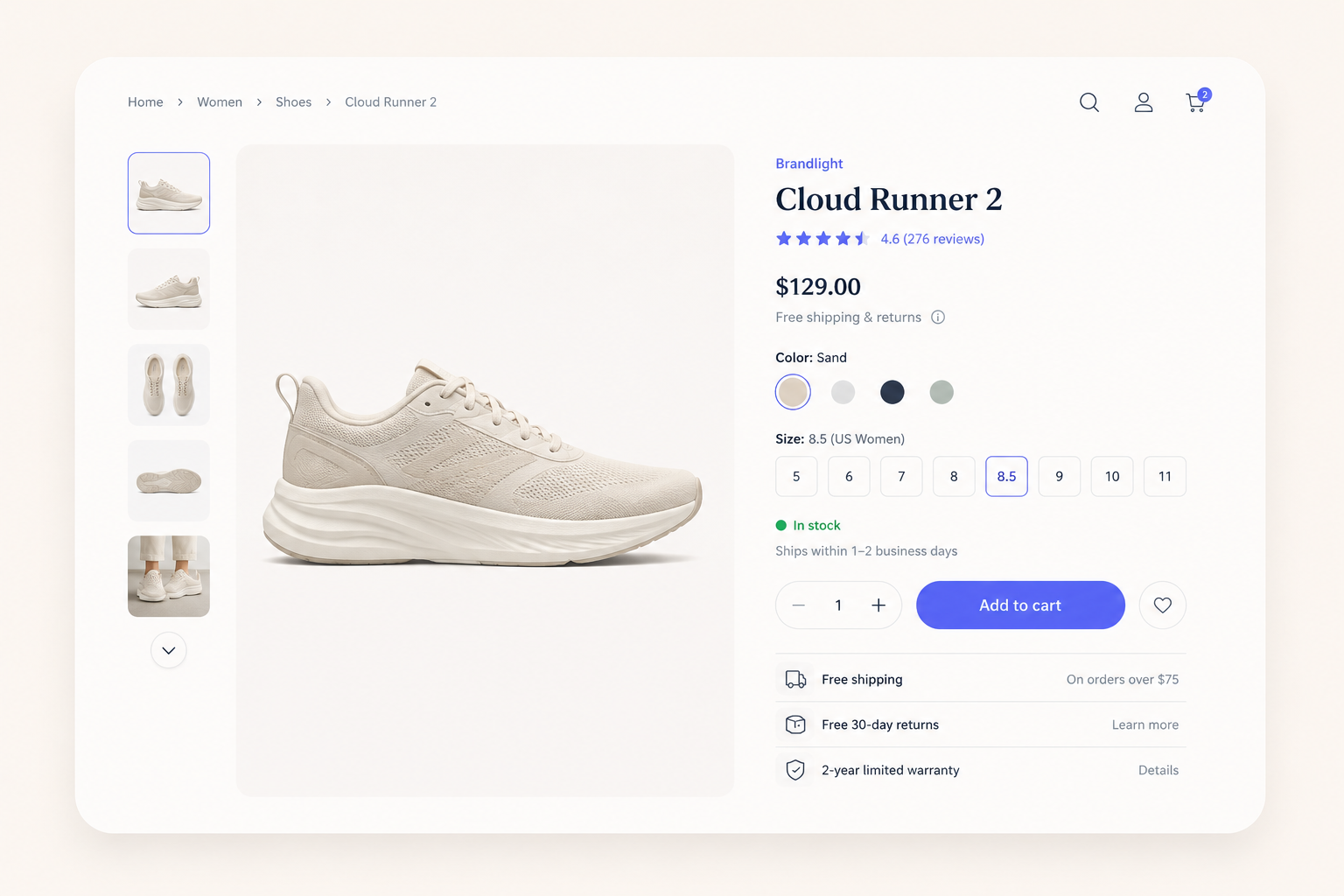
For commerce brands, the pages AI cites most are retailer product pages, not your own .com. You shape them through the content briefs you send retailers. Most brands do not send briefs. The ones that do get cited.
The pattern is blunt. On unbranded queries, page structure influences citations more than brand alone. Two brands in the same category, same retailer, same price range: one earns citations, the other is invisible. The difference is not prestige. It is the six pillars below.
The whitespace is universal. Contextual use-cases, awards, and FAQ are missing on every page, cited brands and invisible brands alike. One route to differentiation.
Six pillars of PDP optimisation
Each one is a Brandlight best-practice rule, made machine-legible and pushed through retailer content briefs. Every play routes through a brief.
Semantic descriptions
Lead with what it is and who it is for. AI relies heavily on semantic retrieval, so meaning matters more than keyword matching. When a shopper asks "best [product] for [occasion]", AI needs product type, notes, occasion, and fit as plain text in the description.
Smells like: crisp apple, warm spice, smooth woods · Best for: office to evening · Choose it if you want a versatile everyday classic.
Notes appear only lower in the page. Occasion, audience and use case are absent. AI cannot extract meaning for situational queries.
- ✓Lead with type and occasionSpell the product type in full (Eau de Toilette, not EdT). State who it is for and when. AI needs this as plain text to match situational queries.
- ✓Put notes and benefits up topDo not bury the substance below a tagline. Benefits ahead of features. Product facts as image-adjacent copy AI can index.
- ✓Cut brand-name repetitionLead with the reason to choose. Brand-name repetition in body copy wastes the semantic space AI uses to match queries.
- ✗Tagline-led openingA tagline communicates brand feel, not product facts. AI cannot answer "what does it smell like?" from "timeless elegance".
- ✗No audience or occasionAI queries are situational. Without an occasion, the page cannot match "best gift for dad" or "office-appropriate fragrance" queries.
Lead with the reason to choose. Spell the type in full, never abbreviate. Cut brand-name repetition from body copy.
Ratings & reviews
The schema and reviews that separate cited from invisible. AI does not just show a star rating. Review text appears to inform the use-cases and sentiment signals that engines surface. AggregateRating + Review schema is the single strongest signal across all cited pages.
AI cannot surface a credibility signal for this page. Zero citations earned across six weeks of reports.
- ✓Mark up ratings prominentlyDisplay ratings on every retailer PDP and mark them up with Review + AggregateRating schema. This is the line between cited and invisible.
- ✓Tag the review themesSurface tagged themes ("fresh", "long-lasting", "office-appropriate") so AI can extract use-case patterns. These themes are what AI surfaces in answers.
- ✓Drive review volume on priority retailersPush recent, tagged reviews to priority retailer pages. More review signal = stronger citation probability.
- ✗No Rating or Review schemaThis is the single most consistent gap between cited and invisible pages. Without it, AI has no structured credibility signal to surface.
- ✗Reviews present but not marked upUnstructured review text is better than nothing, but schema is the superhighway. AI extracts tagged pairs first, not free text.
Reviews schema is the line between cited and invisible. It is present on every cited page and absent on every invisible one.
Contextual use-cases
Tell AI when to use it. AI queries are situational. "Best gift for dad", "best fragrance for the office", "fragrance for a first date." No page we analysed carries any "best for" or "when to use" copy. This is a universal gap and the fastest route to differentiation.
• Spring and summer occasions
• Daytime occasions such as lunches, work or casual outings
• Gifting, thanks to its versatile and widely-loved scent profile
No page in the analysis carries explicit "when to wear" copy. AI cannot answer "Parfum fürs erste Date?" from product description alone.
- ✓Add a "Best for / occasions" blockConnect each product to the specific moments and scenarios it is made for. AI queries are situational. The page must answer them directly.
- ✓Add a "Choose this if..." lineContrast each SKU with the adjacent one so AI can answer comparison queries ("Product A or Product B?") directly from the page.
- ✗Occasion buried in review textReview text is not the same as explicit structured copy. AI needs a distinct "Best for" block it can clearly attribute and cite.
- ✗No cross-SKU comparisonComparison queries ("which is better for evenings?") go unanswered if the page never contrasts one SKU with another.
Add a fundamental reason to buy this over the hundreds of others. Say exactly who it is for and when.
Awards & certifications
Make third-party validation crawlable. LLMs prioritise verifiable, third-party validation when recommending. Crawlers cannot read badges or icons. Only readable text and structured data count. Currently, every validation on most PDPs lives in imagery and is invisible to AI.
Best-seller: Top 3 men's fragrance on Douglas.de · Heritage: Over 25 years in market
No alt text. No crawlable text. No schema. AI cannot read or cite this validation.
- ✓Surface as crawlable textHeritage claims, best-seller rankings, and editorial quotes must exist as plain text on the page. AI cannot read badge images.
- ✓Mark it up in schemaAdd awards to Product schema additionalProperty fields, not just the page body. This makes the claim machine-readable and verifiable.
- ✗Awards only as imageryBadge images without alt text are completely invisible to AI. If validation only lives in graphics, it does not exist for LLMs.
- ✗Empty adjectives without proof"Award-winning" without stating the award is unverifiable. AI requires specificity. "Winner of the 2024 Fragrance Foundation award" is citable. "Award-winning" is not.
Lead with verifiable proof, not empty adjectives. Crawlers can read text and schema, not badges and icons.
FAQ & question targeting
Answer the question on the page. AI queries are conversational questions. Pages with explicit Q&A become the direct source for the generated answer, and FAQPage schema lets engines extract clean pairs. Currently, no PDP in the analysis carries an FAQ section or FAQPage schema.
Is this fragrance suitable for everyday use?
How long does Marc Jacobs Daisy Eau de Toilette last?
What does this Eau de Toilette best suit for?
Can Daisy Eau de Toilette be worn in the evening?
+ FAQPage JSON-LD on every hero PDP
No FAQ tab. No FAQ section. No FAQPage schema. The only question anywhere is a category H2 on the listing page, not the product page. AI cannot extract conversational Q&A pairs from this page.
- ✓5-8 FAQs per hero SKUSeed questions from actual search queries in your market. Answer them directly on the PDP, not in a separate support section.
- ✓FAQPage JSON-LD on every hero PDPSupply pre-written FAQ blocks to retailers in every content brief. FAQPage schema lets engines extract clean Q&A pairs without parsing the full page.
- ✗No FAQ section at allAI queries are conversational. Without explicit Q&A, the page cannot become the direct source for a generated answer.
- ✗Questions only on category pagesCategory-level FAQs do not help AI answer product-specific queries. FAQ must live on the product page itself.
Seed questions from the actual queries in your market. Answer them directly on the page. Supply pre-written blocks to retailers.
Structured data & schema
A strong base already exists. Treat schema as table stakes, but prioritise on-page copy. Product schema lets AI verify price, SKU, availability and facts before recommending. FAQPage and AggregateRating are recommended but it is far more important to have the copy on-page first.
Rating/review markup missing or at ProductGroup level only, not Product level.
No per-variant offers. AI cannot verify individual SKU facts.
- ✓Required JSON-LD minimumProduct {brand, name, description, offers (price, availability, SKU per variant), aggregateRating, review} + FAQPage. This is the minimum to brief into every retailer.
- ✓Carry rating at Product levelRating/review/description at the Product level, not only ProductGroup. AI verifies facts at the individual SKU level before recommending.
- ✗No FAQPage schemaThe most common gap. Product and AggregateRating schema is becoming standard. FAQPage is not yet standard, which makes it a differentiation opportunity.
- ✗Schema only at category levelCategory-level schema does not help AI answer product-specific queries. Schema must be at the individual product page and variant level.
Schema is table stakes. The copy is where you win. Build the copy first, then mandate schema in every retailer brief.
What a fully-applied PDP reads like
Every pillar applied to one page. This is the target state for a content brief to any retailer.
A modern-classic Eau de Toilette built for everyday confidence. Crisp apple, bergamot and a green lift open bright and clean, before an aromatic heart adds warmth. Smooth base notes give it quiet depth and dependable all-day staying power.
Fragrance family: Aromatic Spicy
Top: Apple, bergamot, lemon
Heart: Cinnamon, clove
Base: Sandalwood, cedar, vetiver
- A modern icon, one of the world's most recognised men's fragrances
- A crisp citrus opening that feels fresh, never heavy
- Smooth spiced warmth with dependable all-day wear
- Effortlessly versatile, desk to dinner, weekday to weekend
- Best for: the office and professional settings
- Best for: gifting, a widely loved safe choice
- Choose this if you want a fresher, lighter daily signature
- What does this fragrance smell like?
- Is it appropriate for the office?
- Product A or Product B, which should I choose?
- How long does it last?
- Is this a good gift?
Five things that define the work
Optimised pages get cited. Brand prestige does not move the needle without structure.
Reviews schema is the dividing line between cited and invisible. Present on every cited page, absent on every invisible one.
You shape retailer pages through briefs. Every play routes through a content brief to the retailer. Write them.
Crawlers read text and schema, not badges and icons. If validation lives only in imagery, it does not exist for AI.
Use-cases and FAQ are the whitespace. Missing on every page across every brand. First to add them owns the situational queries.
Want your PDP audit?
We will show you which of the six pillars your retailer pages are missing, and where fixing them earns the most citations.
Book a 30-minute session →